commercial kitchen repair san jose

Opportunities in Sacramento’s Commercial Kitchen Service Industry

The restaurant repair business in Sacramento appears reasonably healthy in 2025, supported by a relatively resilient local restaurant scene and multiple active commercial kitchen service companies, but operators face tight margins and cost pressure from their restaurant customers.

Sacramento restaurant demand in 2025
A DoorDash analysis of 100 U.S. cities reported that Sacramento’s restaurant sector showed unusual resilience in 2025, with about 93% of partnered food businesses still open in September 2025 versus September 2024.

The same report noted a 12.7% increase in the number of food operations joining the platform over the prior year, indicating expanding demand for restaurant-related services in the area.

National restaurant trends affecting repairs
Nationally, the restaurant industry is projected to reach about $1.5 trillion in sales in 2025, with operators still investing to keep kitchens running despite cost pressures, which sustains demand for maintenance and repair.

Restaurants continue to struggle with high food, labor, and operating costs, especially in California, which pushes many to repair and maintain existing equipment longer rather than replace it, indirectly supporting service businesses but keeping their customers price-sensitive.

commercial hvac repair san jose 1200 583

Evidence of active repair providers
Several specialized firms explicitly serving commercial kitchens and restaurants are operating in the greater Sacramento area, such as Golden State Equipment Repair (hot-side and refrigeration), Hobart Service (food equipment and dishwashers), Commercial Appliance Maintenance & Repair, and United Restaurant Mechanical

These companies advertise broad coverage (refrigeration, ovens, dishwashers, prep equipment, exhaust hoods) and long operating histories in the region, which suggests a stable ongoing market rather than a shrinking niche.

Practical implications if you’re considering this business
With most DoorDash-partnered restaurants still open and more joining the market, there is ongoing demand for reliable same-day or rapid-response repair, especially for refrigeration and hot-side equipment that directly impacts revenue.

The main business challenge is likely to be pricing and efficiency, because your restaurant customers are under margin pressure and may prioritize vendors who can minimize downtime and offer predictable costs or maintenance contracts.
young latino repair man fixing commercial refrigerator

Commercial Refrigerator Repair in Sacramento

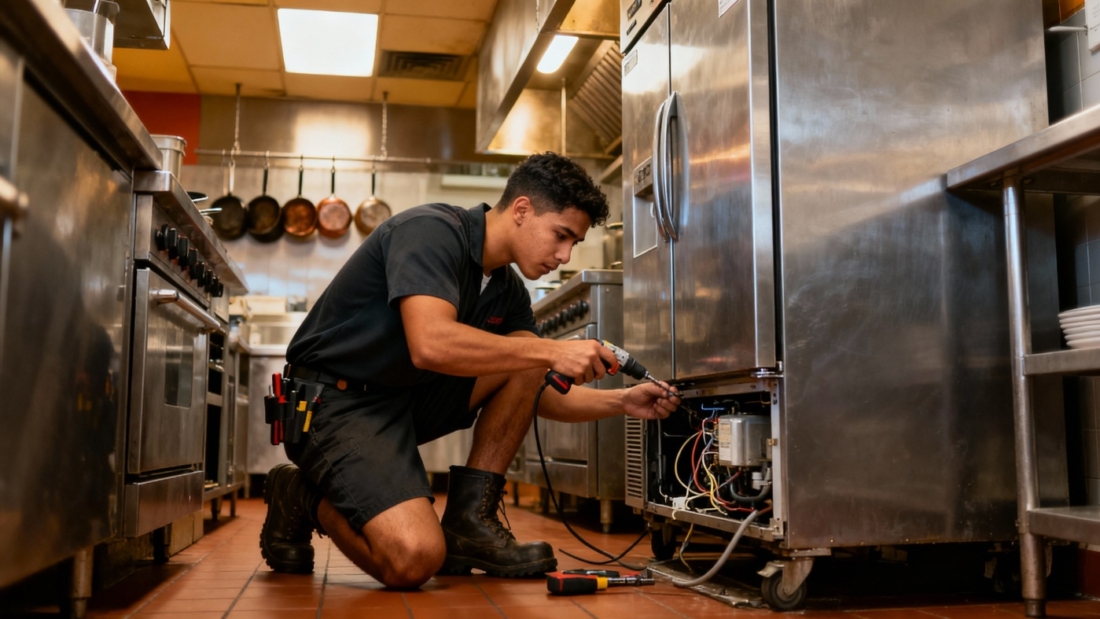
When your commercial fridge stops working, every minute matters—product and profits are on the line. United Restaurant Mechanical delivers fast, expert commercial fridge repair for Sacramento businesses, including restaurants, markets, and bakeries. Our experienced technicians quickly identify the problem, provide transparent pricing, and use only certified OEM parts to ensure lasting repairs.

We handle all brands and types of commercial refrigeration, from walk-in coolers to display cases and prep tables. Common issues like temperature instability, frost build-up, water leaks, and compressor failures are no problem for our team. We offer priority service, rapid response, and warranty-backed repairs to get your fridge working and your business running smoothly again.

Serving Sacramento and surrounding cities, United Restaurant Mechanical is your trusted partner for reliable, efficient commercial fridge repair. Don’t risk inventory loss—contact us today and protect your cold chain with the experts who care about your business as much as you do.

commercial refrigerator

 Call us for a free estimate today!  800-595-0677

The top commercial refrigerator brands in 2025 are:

  • True Refrigeration: Known for durability, reliability, and heavy-duty construction, a top choice for busy commercial kitchens.
  • Traulsen: Considered the gold standard with high-quality, long-lasting units suitable for demanding environments.
  • Continental: Made in the USA, known for excellent build quality and dependability.
  • Hoshizaki: Famous for ice machines and also top-tier refrigerators focusing on food safety and precise temperature control.
  • Arctic Air: Focuses on reliability, efficiency, and solid construction for commercial use.
  • Foster: Renowned for quality, durable units built for professional settings.
  • Liebherr: Offers precision engineering and stable, efficient cooling.
  • Perlick: Known for bar and beverage equipment, also delivers reliable commercial refrigeration.
  • Miele and Thermador: Premium brands with advanced technology, durability, and design.
  • LG, Bosch, Whirlpool, and Sub-Zero: Highly reliable with advanced technology, long lifespan, and popular in both home and commercial settings.

These brands are praised for their quality, reliability, performance, and suitability for commercial kitchens with varying budget levels, from premium to more affordable options.

Commercial Refrigeration Maintenance Checklist

Properly maintaining your commercial refrigeration units is essential for preserving product quality, reducing downtime, and extending equipment lifespan. Follow this concise checklist quarterly to ensure peak performance:

  • Clean interior and exterior: Wipe shelves, bins, walls, and handles to remove spills and debris.
  • Inspect refrigerant levels: Ensure refrigerant levels meet manufacturer specifications, checking for leaks.
  • Clean condenser coils: Remove accumulated dust and dirt with a soft brush.
  • Check door seals: Inspect for cracks, tears, or gaps; replace if damaged for optimal insulation.
  • Monitor temperature settings: Calibrate and verify settings are accurate within safe ranges.
  • Inspect evaporator fans: Confirm proper operation and clean fan blades.
  • Clean drain lines: Clear obstructions to allow proper condensation drainage.
  • Test defrost cycle: Verify accurate operation to prevent ice buildup.
  • Inspect electrical components: Check all wiring, controls, and connections for damage or corrosion.
  • Document maintenance activities: Log inspections and repairs for compliance and future reference.

Daily/Weekly: Clean surfaces and check temperature settings.
Monthly: Clean coils, inspect seals, drains, filters, and compressor fins.

Implementing these steps, plus leveraging IoT monitoring and automation tools, helps achieve regulatory compliance, energy efficiency, and operational reliability.

Got a question about our maintainance checklist ? Call 800-595-0677

We service most of these popular manufacturer brands.

  • True Manufacturing
  • Turbo Air
  • Traulsen
  • Hoshizaki
  • Kintera
  • Miele
  • Viking
  • Foster
  • Continental
  • Perlick
  • Accucold
  • Carrier
  • Trane
  • Lennox
  • York
rooftoop hvac exhaust blower repair web

Keep Your Sacramento Business Running Smoothly: The Ultimate Guide to Commercial HVAC

In the Sacramento Valley, extreme weather isn’t just a comfort issue—it’s a business risk. A failing HVAC system can halt operations, damage inventory, and hurt productivity. That’s why smart businesses prioritize a robust climate control strategy. Expert Sacramento Valley commercial HVAC services are essential for keeping your office, retail space, or industrial facility comfortable and compliant. It starts with a professional installation. Using top brands and advanced load calculations, technicians can design energy-efficient HVAC systems Sacramento that are tailored to your building. This means eliminating hot spots, improving air quality, and potentially slashing utility bills by up to 30%. A proper setup, from rooftop units to VRF technology, ensures you meet local codes and operate at peak efficiency from day one.

commercial hvac

But installation is just the beginning. The real key to avoiding costly downtime is proactive care. Partnering with a team that offers comprehensive preventative HVAC maintenance Sacramento is crucial. Regular tune-ups, filter changes, and diagnostics catch small problems before they become major emergencies. This extends your equipment’s life and ensures you’re never caught off guard during a heatwave or cold snap.

Of course, emergencies still happen. That’s when you need reliable commercial HVAC repair Sacramento. Look for specialists with 24-hour availability and fully stocked vehicles to resolve issues on the first visit. From server room cooling to boiler repairs, a dedicated partner protects your assets and keeps your business focused on growth, not a faulty thermostat.  Investing in a specialized HVAC partner means safeguarding your operations. From 24-hour HVAC service Sacramento to automated controls and air balancing, a full-service provider delivers peace of mind, year-round.

commercial refrigeration

6 Essential Steps for Commercial Refrigeration Maintenance

Keeping your commercial refrigeration system in top condition is critical for food safety, efficiency, and long-term performance. Here are six essential maintenance steps every business should follow:

1. Clean Interior & Exterior Surfaces

Empty the unit regularly and scrub shelves, walls, and bins with warm soapy water or a refrigerator-safe cleaner. On the outside, use a soft cloth or microfiber rag with mild detergent. For stainless steel, finish with a polish for a like-new shine.

2. Maintain Condenser & Evaporator Coils

Dirty coils trap heat and strain your system. Use a coil cleaner, small brush, or compressed air every three months. Realign bent fins with a coil comb. For evaporator coils, remove grease and grime to ensure proper airflow, especially if located near cooking equipment.

3. Replace or Clean Air Filters

Clogged filters block airflow and reduce cooling efficiency. Inspect filters frequently, vacuum out dust and grease, and replace them if damaged or excessively dirty.

4. Clean Drain Pans & Tubes

Sludge and food debris can clog drain lines, leading to overflow or freezing. Clean pans and tubes monthly with warm, soapy water to prevent buildup and contamination.

5. Inspect Door Gaskets

Worn or cracked gaskets cause cold-air leaks, food spoilage, and higher energy bills. Clean them monthly and replace immediately if damaged.

6. Remove Moisture & Keep Unit Dry

Check for condensation or spills behind shelves and wipe them weekly. Excess moisture can freeze, overwork the compressor, and shorten equipment life.

By following these six steps consistently, you’ll extend your system’s lifespan, improve energy efficiency, and protect your business from costly breakdowns.

commercial refrigeration
restaurant repair sacramento web

5 Ways to Slash Restaurant Equipment Repair Costs

commercial hvac repair san jose 1200 583
Jobs Corp Logo

Frasco Mechanical selected by San Diego Job Corps

Oct. 3,2013
Imperial Beach, California

Frasco Mechanical has been selected as the primary mechanical services company for the San Diego Job Corps

Frasco Mechanical has been selected as the primary mechanical services company for the San Diego Job Corps in Imperial Beach California. Hans Hartwig and Carl Williams of San Diego Job Corps will oversee all aspects of Frasco repair services.
San Diego Job Corps
job corps logo

Job Corps is a no-cost education and career technical training program administered by the U.S. Department of Labor that helps young people ages 16 through 24 improve the quality of their lives through career technical and academic training. The Job Corps program is authorized by Title I-C of the Workforce Investment Act of 1998. The San Diego Job Corps Center supports the Job Corps program’s mission of teaching eligible young people the skills they need to become employable and independent and placing them in meaningful jobs or further education.

Service Technician

How to find a good service technician

by Back Burner News

There are many maintenance tasks that can safely be performed by restaurant owners that would save a substantial amount of money on service calls. Here are some of the things restaurant owners can do to keep service calls to a minimum.

Knowledge of a Technician

You might be surprised to find that many service technicians that routinely charge well over $100 a hour, have only a high school education… or less. I don’t say this to displace anyone’s profession, but yet to inform the general public.

It’s not formal education that helps most technicians stand out from others, but years of experience that makes them experts. The vast majority of technicians learned from other technicians or attended a community college program to attain enough knowledge to work as a technician on restaurant equipment. Some have also attended a specialty course to be able to work with refrigerant (freon), but nonetheless, most learn by doing, and the longer they have been working in the field, the more they know. Maybe you can do it yourself.

I have no way of knowing how “mechanically inclined” you or your staff may be, but I can tell you from experience that not everyone is. With that said, most of the information you need you already have (or should have) in the form of the manual that came with the equipment. I know it’s a boring read, but you should read through these manuals when you receive any new piece of equipment. Some are just installation guides that will offer almost none of the information you need, but the user’s guide, on the other hand, can have a lot of very useful information – especially when it comes to equipment repair.

lookingforgoodservicetechnician

Most companies offer an additional manual that may (or may not) come with the equipment, and are full of good information that is useful in maintaining equipment – they are often called a “service manual” or “parts and service manual.” Most of the time you can download a copy free of charge from the manufacturer’s website. This is the most useful manual you can own for the repair of a piece of equipment. It will have a parts breakdown that will show you drawings of every part and how those parts fit together. Often it will have a troubleshooting section that will identify a specific problem and give you possible remedies to fix it.

The last way to become informed on your specific equipment is by the use of the technical service line almost all manufacturers offer. I list this last because these lines are set up for service personnel, but I can tell you from experience that as an owner or manager you will not be turned away if you call. If it is a good company, the person you speak with will have worked on that piece of equipment before, and will know enough about it to understand what you are trying to explain, even if you don’t know the technical terms to use.

If you call, you will need the model number and serial number along with any other information you can get off the equipment. It is helpful to have a parts breakdown (drawing) of the equipment in front of you, so you can see what the various parts look like and be able to call a part by name. You should also be able to explain to the technician on the other end of the line what the machine is doing (or not doing). You can usually find an 800 number for tech service on the manual or by using the contact us section of the company’s website.
Article by Kevin Loving

what oven to buy

What oven do I buy for my restaurant ?

Buying the Right Oven – by Dan Bendall

In most foodservice operations, you need at least one type of oven, but the trick is to be sure that you match your cooking needs to the proper oven type and size. Here are some of the oven types that will likely fit your needs.

Deck Ovens. The standard deck of a deck oven is built of steel and made to hold baking pans. Most are also available with a stone hearth for baking breads and pizzas directly on the deck. A good deck oven can run from several thousand dollars to well over $20,000. It provide superior browning for items such as chicken, fish, casseroles and, of course, pizza. Footprints range from an 18” square countertop deck unit to 84” x 51” deck ovens geared for high-volume restaurants. Operators can also stack three to four oven decks to increase capacity and production.

When specifying a deck oven for an existing operation, confirm that the unit will fit through necessary doorways into the kitchen. You may have to remove the legs on some models to fit through narrow spaces.

Convection Ovens. The convection oven adds forced-air movement to reduce cook times. Convection ovens can often be operated at a lower temperature than traditional deck ovens while cooking more evenly. In operation, the results are consistent temperatures throughout the oven, meaning pans usually do not need to be shifted or turned during cooking as is often necessary in a deck oven. Also, several tiers of product can be cooked in the same convection oven cavity while achieving an evenly baked product throughout..

Low Temp and Cook & Hold. Low-temperature roasting is usually done at 200°F to 225°F for long periods to reduce shrinkage. These ovens are often not required to be under a hood and they can be purchased with casters so they can be wheeled around.

Some other things to consider about low-temp ovens: Some are available with smoker attachments, convenience foods can be prepared well in cook and hold ovens and frozen prepared items are often well suited for low-oven cooking.

High-Speed-Ovens. Many high-speed ovens use hot-air jets to strip away the cool layer around food better than a traditional convection oven where air is only blown across the surface to be cooked. The process is able to bake a pizza or other thin items in less time than conventional means. Batch ovens, which also cook at high speed, are usually countertop units with doors about two feet square. They generally do not require hoods, and often use microwaves as an additional energy source to penetrate the product and cook food even faster.

Also consider conveyor ovens, which are available from countertop models to stackable floor units. Countertop models have narrow conveyor belts of 14” to 18” wide, good for one platter or pizza. The counter top and floor models are often stackable.

Things to consider when purchasing an oven:

• In most areas of the country, gas is less expensive to use compared to electricity, but availability of utilities and local fuel costs should be a determining factor in the fuel source decision.

• Exhaust hoods are usually required over gas and electric ovens. A true wood-burning oven will always require a hood and fire protection and may have other local restrictions.

• Have gas oven burners calibrated on a regular basis for optimum fuel efficiency and best product heating. Electric ovens should also have the elements checked and have the temperature calibrated periodically.

• If using electric ovens, high voltage units are often less costly in terms of energy usage.

• Stainless steel exterior surfaces are often worth the extra cost in increased life and easy clean up.

• Purchase only an NSF listed oven for sanitary features and AGA certified gas equipment and UL listed electric models. Look for ENERGY STAR electric and gas convection ovens.

Dan Bendall is a principal of FoodStrategy, a Maryland-based consulting firm specializing in planning foodservice facilities. He can be reached at dbendall@foodstrategy.com.

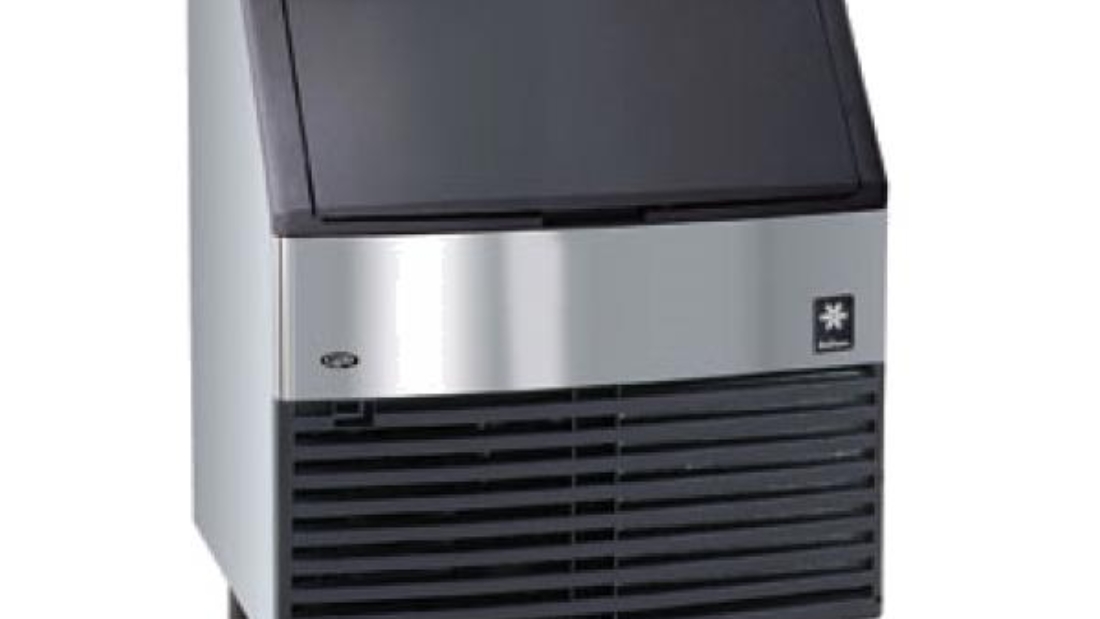
manitowoc ice machine

What Ice Machine should I Buy and Why?

So you want to buy an ice maker? What ice maker issues and considerations are important, and which ones are not? Well, Scotsman reminds you of a kilt; Hoshizaki has a penguin on their logo, Cornelius sounds like a vegetable, Ice-O-Matic sounds Irish, and Manitowoc machines have an interesting name. So maybe if you like penguins, your decision will be easy. But unfortunately, wise decisions are not made on such grounds. So on what grounds is a wise ice maker purchase decision made; If not penguins, then what?

First of all, we will clearly state that the only ice makers that we will consider are the ones manufactured by Manitowoc, Hoshizaki, and Scotsman. There are many other ice maker manufacturers, including Cornelius and Ice-O-Matic, but being in the refrigeration business for over 50 years has taught us that these three makers make up the great majority of ice machine purchases for a reason. Manitowoc, Hoshizaki, and Scotsman are reputable, well-designed, and backed by dependable service warranties. So now the question is: should I buy a Manitowoc, Hoshizaki, or a Scotsman? In a moment,we will look at a detailed comparison between Manitowoc, Hoshizaki, and Scotsman ice makers. We will specifically consider their ease of repair and their evaporators (the ice maker’s crux component).